
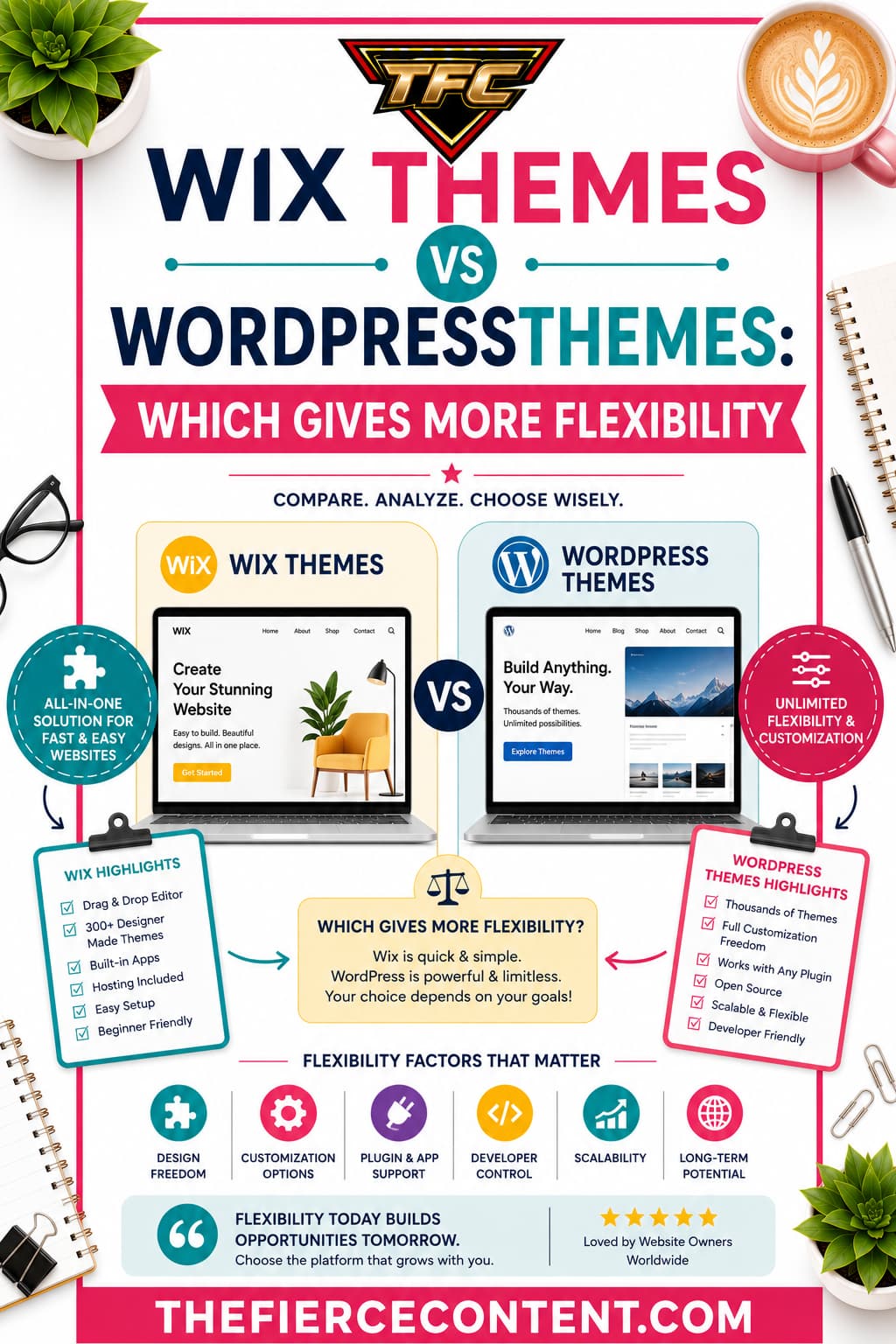
Choosing between Wix and WordPress is not just about design, it’s about how much control you want over your website now and in the future.
Both platforms allow you to build beautiful websites using themes (WordPress) or templates (Wix), but they are fundamentally different in how much freedom they give you. One is a closed system designed for simplicity, and the other is an open ecosystem built for maximum customization.
So which one is more flexible?
👉 WordPress themes are significantly more flexible than Wix themes. But let’s break down exactly why in a clear, practical way.
1.What Are Wix Themes vs WordPress Themes?
Before comparing flexibility, it’s important to understand how both systems work.
Wix Themes (Templates)
Wix uses pre-designed templates inside a closed platform. Once you choose a template:
You customize it using drag-and-drop tools
You stay inside Wix’s system
You cannot fully change the underlying structure
Wix is designed to be simple, so everything is controlled within its ecosystem.
WordPress Themes
WordPress themes are open and customizable design frameworks.
You can: Install thousands of themes (free or paid)
Edit code (HTML, CSS, PHP)
Use page builders like Elementor or Gutenberg
Fully modify layouts, structure, and functionality
This makes WordPress an open-source system with far fewer restrictions.
As confirmed by industry comparisons, WordPress provides far deeper customization options due to its open ecosystem and plugin system.
2. Flexibility Comparison: The Core Difference
This is where the gap becomes very clear.
Wix Flexibility (Limited but Easy)
Wix offers: Drag-and-drop design freedom
Built-in hosting and tools Pre-set layout structures
But it also has limitations:
You cannot switch templates without rebuilding the site
Limited access to code and backend structure
Restricted advanced customization options
Wix is flexible visually, but not structurally.
In other words, you can move things around, but only within Wix’s rules.
WordPress Flexibility (Extremely High)
WordPress gives you:
Full control over theme files
Unlimited design changes
Thousands of plugins to extend functionality
Ability to build custom features
You can:
Change themes anytime without losing content
Customize layouts deeply
Add advanced features like memberships, booking systems, or marketplaces
WordPress is considered the most flexible website platform because of its open-source architecture and massive plugin ecosystem.
3. Design Freedom: How Much Can You Actually Change?
Wix Design Freedom Wix allows you to: Drag elements anywhere on the page Choose fonts, colors, and layouts Add sections and animations But: Layouts are still partly locked
Some design elements cannot be fully customized
Mobile layout adjustments are sometimes separate from desktop editing
This can create frustration when you want precise control.
WordPress Design Freedom
WordPress allows:
Full layout rebuilding using themes or builders
Deep customization via CSS and code
Advanced design systems (grid layouts, dynamic content)
Complete mobile + desktop control With tools like Elementor or Divi,
WordPress becomes a full visual design platform with near-unlimited flexibility.
4. Theme Switching: A Huge Flexibility Difference
Wix You cannot switch templates freely
If you change your template, you often must rebuild your site
Content and design are tightly connected
This is one of Wix’s biggest limitations.
WordPress You can switch themes anytime
Your content remains intact
Only design styling may need adjustment
This alone makes WordPress far more flexible for long-term growth.
5. Plugin and Feature Expansion
Wix
Wix offers an App Market with built-in integrations:
Basic SEO tools
Booking systems
Simple ecommerce tools
However: The app ecosystem is limited
Advanced features may require higher-paid plans
You cannot install fully custom plugins freely
WordPress
WordPress has over 50,000+ plugins that allow you to:
Build online stores (WooCommerce)
Add SEO optimization tools
Create membership systems
Add advanced analytics
Integrate APIs and automation tools
This is where WordPress becomes far more powerful and flexible.
6. Scalability: What Happens When Your Website Grows?
Wix Scalability
Wix works best for:
Small business sites
Portfolios
Simple blogs
But as your site grows:
Custom functionality becomes limited
Migration to another platform is difficult
You remain inside Wix’s ecosystem
WordPress Scalability
WordPress is built for growth:
Can handle small blogs to enterprise websites
Supports complex systems (eCommerce, LMS, SaaS portals)
Fully portable between hosting providers
This makes it a long-term scalable solution.
7. SEO Flexibility
Wix SEO Basic
SEO tools included Simple meta tags and settings
Limited technical SEO control
WordPress SEO Full control over technical SEO
Advanced plugins like Rank Math or Yoast
Better control over speed, structure, schema, and indexing
WordPress gives far more flexibility for SEO optimization.
8. Ease vs Flexibility Trade-Off
This is the most important reality:
Wix = Easier, but limited flexibility
WordPress = More complex, but maximum flexibility As one comparison explains: Wix is easier for beginners WordPress requires more setup but gives full control and scalability
9. Real-World Example (Simple Analogy)
Think of it like this:
Wix is like renting a furnished apartment
Everything is ready
You can decorate and move furniture
But you cannot change the structure
WordPress is like owning a house You can redesign everything
Add rooms, rebuild walls, expand freely
But you are responsible for maintenance
Which Is More Flexible? 👉
WordPress themes are far more flexible than Wix themes
Why?
Because WordPress offers:
Full design control
Unlimited plugins
Theme switching freedom
Deep customization via code
Long-term scalability
Wix is: Easier to use Faster to set up But significantly more restricted
Key Takeaways
If your goal is simplicity and speed, Wix is a great starting point.
But if your goal is freedom, scalability, and long-term growth, WordPress is the clear winner.
In short:
Wix = simple control, WordPress = unlimited flexibility