
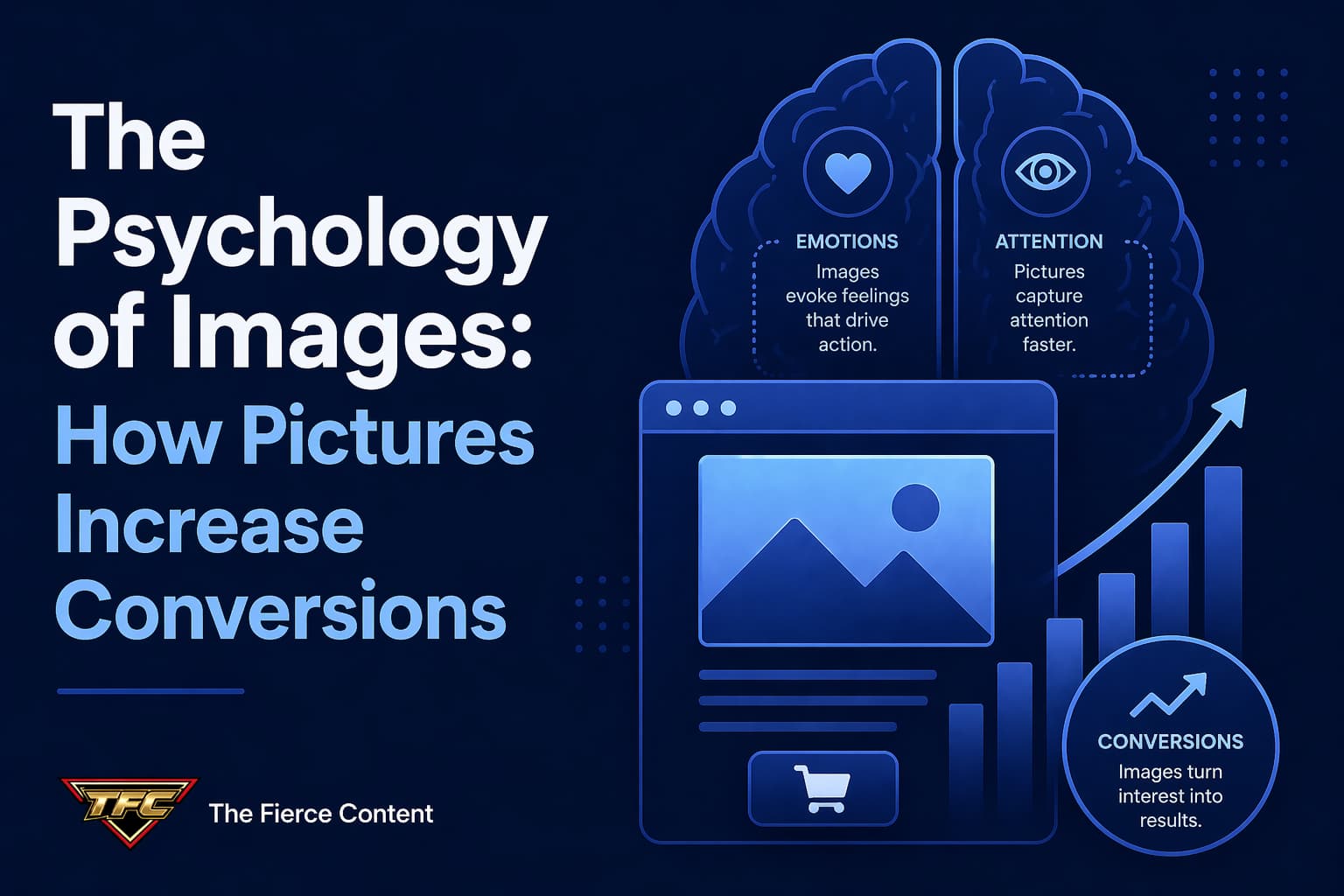
Images are not just visual fillers on a website, they are powerful psychological triggers that influence how people think, feel and ultimately decide to take action.
If you’ve ever bought something online because “the product just looked good,” or trusted a website more because it looked professional, you’ve already experienced image psychology in action.
The truth is simple:
people don’t convert because of text alone. They convert because of what they see and how that visual information makes them feel.
In this post, we’ll break down the psychology behind images, why they increase conversions and how you can use them strategically on your blog, landing pages, or affiliate content to drive real results.
This isn’t about guesswork. It’s about understanding how the human brain processes visuals and using that knowledge to improve your content performance.
Why Images Are More Powerful Than Words Alone
Let’s start with a simple truth: humans are visual creatures.
More than 50% of the brain is involved in visual processing. That means when someone lands on your website, they are not “reading” first, they are seeing first, thinking second and deciding after that.
This is why images have such a massive impact on conversions.
You can write the most persuasive copy in the world, but if your visuals are weak, outdated or confusing, your conversions will suffer.
On the other hand, strong, intentional visuals can increase trust, reduce hesitation and guide users toward action almost effortlessly.
Think about landing pages you’ve visited. The ones that felt trustworthy likely had:
Clean, high-quality images
Clear product visuals
Human-centered imagery
Emotionally appealing design
Now compare that to a page with blurry or generic stock photos.
Even if the text is identical, your trust level drops immediately.
That’s psychology at work.
Images don’t just decorate content, they shape perception.
And perception drives conversion.
In this post, I’ll explore exactly how and why that happens.
How the Brain Processes Images (The Science Behind Visual Power)
To understand why images increase conversions, we need to understand how the brain processes visual information.
The human brain processes images significantly faster than text. In fact, visuals are processed in milliseconds, while reading requires more cognitive effort and time.
This means that before a visitor reads a single word on your page, they’ve already formed an opinion based on visuals alone.
This is known as “pre-attentive processing.” It’s the brain’s way of quickly scanning the environment and making rapid judgments about trust, safety and relevance.
Here’s what happens in seconds:
The brain scans the page layout
It evaluates images for emotional cues
It forms an initial trust judgment
It decides whether to stay or leave
This is why first impressions matter so much in digital marketing.
Images also activate emotional processing centers in the brain. Unlike text, which requires interpretation, images trigger immediate emotional reactions.
These emotions strongly influence decision-making.
For example:
Warm, human images increase trust
Clear product visuals reduce uncertainty
Lifestyle images increase aspiration
Confusing or low-quality visuals create doubt
The brain is constantly asking one question when it sees an image: “Is this safe, relevant and worth my attention?”
If the answer is yes, engagement increases. If the answer is no, users leave.
This is why image quality, relevance and context are not just design choices, they are psychological conversion tools.
Emotional Triggers: Why People Buy What They Feel
One of the most important principles in marketing psychology is this: people don’t buy based on logic alone, they buy based on emotion and justify with logic afterward.
Images are one of the fastest ways to trigger emotion.
Different types of images create different emotional responses:
Human faces:
Human faces build trust and connection.
When users see real people in images, especially with eye contact or natural expressions, they subconsciously feel more comfortable.
Lifestyle imagery:
Images showing real-life usage create aspiration.
They help users imagine themselves using a product or service, which increases desire.
Before-and-after visuals:
These trigger transformation psychology.
They show contrast, which helps users visualize outcomes more clearly.
Product-in-use images:
These reduce uncertainty. Instead of guessing how something works, users see it in action.
Minimal, clean visuals
These reduce cognitive overload and make decisions feel easier.
Emotion is the bridge between attention and action.
If an image makes a user feel something, comfort, excitement, curiosity, trust, they are far more likely to convert.
But if your images feel generic, stock-like, or emotionally flat, they fail to influence behavior.
That’s why emotional alignment between your images and your message is critical.
Trust Signals: How Images Build or Break Credibility
Trust is the foundation of every conversion.
If users don’t trust your website, they won’t click, subscribe or buy, no matter how good your offer is.
Images play a major role in establishing or destroying trust within seconds.
High-quality, authentic visuals signal professionalism. They tell users that the brand is credible, established, and worth engaging with.
On the other hand, low-quality or irrelevant images create doubt. Users may not consciously think “this looks untrustworthy,” but their behavior reflects it, they leave.
Here are key trust-building image factors:
Authenticity:
Real photos outperform overly staged or generic stock images.
Users are becoming increasingly good at detecting “fake” visuals.
Consistency:
When all images follow a consistent style, tone and quality level, it signals stability and professionalism.
Context relevance:
Images that clearly match the topic reinforce message clarity and reduce confusion.
Human presence including people in images often increases trust because it adds relatability and emotional connection.
Brand alignment:
Custom visuals, branded graphics and consistent color schemes improve recognition and credibility.
Trust is fragile. Once broken, it’s difficult to rebuild.
That’s why image selection should always prioritize credibility over aesthetics alone.
A beautiful image that feels irrelevant or artificial will hurt conversions more than a simple but authentic one.
Cognitive Load: Why Simplicity Increases Conversions
Cognitive load refers to how much mental effort a user needs to understand something.
The higher the cognitive load, the lower the chance of conversion.
Images play a powerful role in reducing cognitive load by simplifying information.
Instead of forcing users to read long explanations, visuals can communicate ideas instantly.
For example:
A diagram explains a process faster than a paragraph.
A screenshot clarifies instructions better than text alone.
A product image removes uncertainty instantly When cognitive load is low, decisions feel easier.
And when decisions feel easier, conversions increase.
This is why landing pages with clear, simple visuals often outperform text-heavy pages.
However, there’s an important balance.
Too many images can increase cognitive load instead of reducing it. If users are overwhelmed with visuals, their attention becomes fragmented.
The goal is clarity, not clutter.
Each image should serve one purpose:
Explain
Simplify
Reinforce
Demonstrate
If it doesn’t do one of these, it likely doesn’t belong.
Reducing cognitive load is one of the most underrated conversion strategies in digital marketing and images are one of the most effective tools to achieve it.
- Visual Hierarchy: Guiding Users Toward Action
Visual hierarchy is how elements on a page are arranged to guide user attention.
Images are a key part of this system because they naturally draw the eye faster than text.
When used strategically, images can guide users toward conversion points such as:
Buttons
Forms
Affiliate links
Product sections
Here’s how it works:
Large, relevant images naturally attract attention first. If placed correctly, they can direct users downward through the content in a structured flow.
For example:
Hero image → builds first impression
Supporting images → explain benefits
Product images → build desire
CTA section → drives action
This creates a psychological journey from curiosity → understanding → trust → action.
Poor image placement breaks this flow.
If images are random or distracting, users lose direction and engagement drops.
Another important factor is directional cues. Images that include eye direction or pointing gestures can subtly guide attention toward key elements like buttons or forms.
This is not manipulation, it’s usability design. You are helping users navigate content more easily.
When visual hierarchy is done well, users don’t feel “guided.” They feel like everything just makes sense naturally.
And that seamless experience is what increases conversions.
The Role of Relevance: Why Context Matters More Than Beauty
One of the biggest mistakes in visual marketing is choosing images based on aesthetics instead of relevance.
A beautiful image that doesn’t match your message will always underperform a simple but relevant one.
Relevance is what connects visuals to intent.
If a user is reading about “affiliate marketing strategies” and sees unrelated lifestyle stock photos, the connection breaks.
Their brain experiences inconsistency, which reduces trust and engagement.
On the other hand, relevant images reinforce understanding.
They tell the brain: “This image supports what I’m reading.”
This reinforcement strengthens memory, improves comprehension and increases conversion probability.
Relevance also affects SEO indirectly. Search engines analyze surrounding content to understand image context. When images align with text, topical authority increases.
The key rule is simple: every image must serve the content’s intent.
Ask yourself:
Does this image support the message? Does it clarify or reinforce the idea? Does it help the user understand faster? If the answer is no, it’s better to remove it.
In conversion-focused content, relevance always beats decoration.
Conclusion:
Images Are Psychological Conversion Tools, Not Just Visuals If you strip everything down, one truth remains: images influence decisions before words ever get a chance.
They shape first impressions, build trust, reduce confusion and guide users toward action, all within seconds.
This is why understanding the psychology of images is not optional for modern content creators. It is essential.
When you choose images strategically based on emotion, relevance, clarity and trust you are not just improving design. You are actively increasing conversions.
The best-performing websites and blogs don’t rely on random visuals. They use intentional imagery that aligns with user psychology at every step of the journey.
If you want higher engagement, better trust and more conversions, start treating images as strategic assets, not decoration.
Because in digital marketing, what people see often determines what they do.